From its birth, not in freedom but grievance, MAGA has always looked back to a past that never existed. The seed was planted in a longed-for Garden of Eden for white Christians, well-coifed men like Mike Johnson, self-made like Brett Kavanaugh, Barbie-looking women who couldn’t vote but could submit and child-bear, isolationists, and of course a very few fabulously wealthy chosen ones. And the garden was always theirs.
In this land of make believe, there are no Indigenous peoples, no slavery — at least no bad slavery. Not the kind of slavery where someone would be mercilessly whipped for trying to be free. And this is why MAGA will fail. Because that history already happened and the struggle to erase it is not only futile, but embarrassing, it betrays the core weakness of the movement. There is no truth to it. No there there, no matter how many times Ofdonald Leavitt snarls at the press pool that, goddammit, the president said so!
The history of the United States is dark and the current attempt to whitewash it reeks of desperation and fear. Desperate to suppress votes. Fearful of the inevitable. The United States, for all its grave failings, is a progressive nation, soon to be a minority white nation.
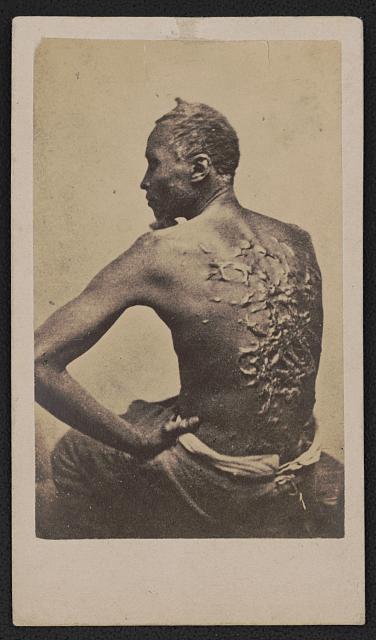
The president’s directive to the National Park Service recently to remove the photograph known by the chilling title “The Scourged Back,” was another low point for the administration. This happened. His name was Gordon. It is as hard to imagine his courage as it is to understand the hatred at the other end of the whip. Our present scourge is called MAGA; while it will fail, more harm will come. Let’s honor the man in this image, whose blood ran red like yours and mine, by remembering that he risked everything for the same freedom we want for ourselves and our children.
How did the image come to be? It was made when Gordon, after surviving his scourge, escaped his tormenters and joined the Union Army. There is something graceful in his pose, one hand on his hip, his head turned almost elegantly to the side as if to look back without shame or fear at the photographers. I am here. I am a man.
That indelible image was made in 1863. Not 27 years later, another searing wartime photo was taken, this one in the Midwest, near Wounded Knee Creek. After the massacre there — carried out with a lethality that Pete Hegseth longs for by the same calvary unit once led by George Custer — a bitter three-day blizzard ensued. Children, women and men were left where they lay. Their corpses froze. The blizzard lifted on New Year’s Day, 1891.
Among them was Lakota Chief Spotted Elk. He was by then an elderly man and not in good health. He was looking forward to seeing his friend Red Cloud at the Pine Ridge Reservation. Like so many of his people murdered that day, he was unarmed. The image is an unnerving reminder of how much was lost in the genocidal U.S. campaign to clear the country of its original peoples. In an attempt to erase a culture, we — white European American protected by military force (sound familiar?) — permanently stained our own.
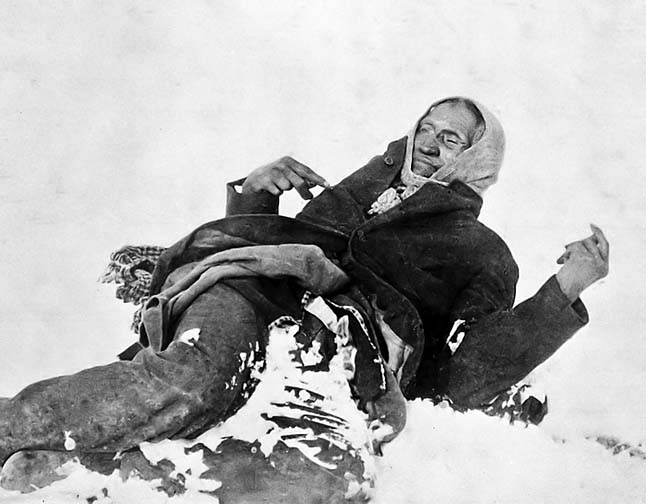
Because of the blizzard, the moment of the massacre is literally frozen in time. It is as we are on the scene. Spotted Elk’s arms are raised, his head is lifted. Like he had slipped and fallen in the snow and is about to arise and rejoin his people.
Both images not only recorded history but helped to shape it. The photograph of Gordon fueled the abolitionist movement. The photograph of Spotted Elk was greeted with revulsion by Eastern progressives who insisted on more transparency and fairness in Washington’s handling of the “Indian problem.”
One can’t help but think of Emmett Till. The year is 1955. A young boy is brutalized and lynched by a white mob. The savage beating left him badly disfigured. Yet his mother, Mamie Till-Mobley, insists on an open coffin. “Let the world see,” she said. “Let the people see.” Again, history is recorded and shaped. Mamie’s courage and Emmett’s senseless sacrifice helped propel the Civil Rights Movement.

What are the images we will look back on as capturing the dark days of MAGA? It will not be the idiotic AI trolling manufactured in the White House itself. It will not be fake eyelashes and red ties and hair gel. Some of the lasting images certainly will be of ICE. A shadow army operating outside the law, plauging our communities. Who are these masked Proud Boys body slamming women, gang tackling men face first in the street, smashing car windows, handcuffing entire families in the middle of the night, breaking bones, yanking parents from children?
You’ve seen them. These images of MAGA will be erased never.

 Kevin Curnin